
The Government of Emergency
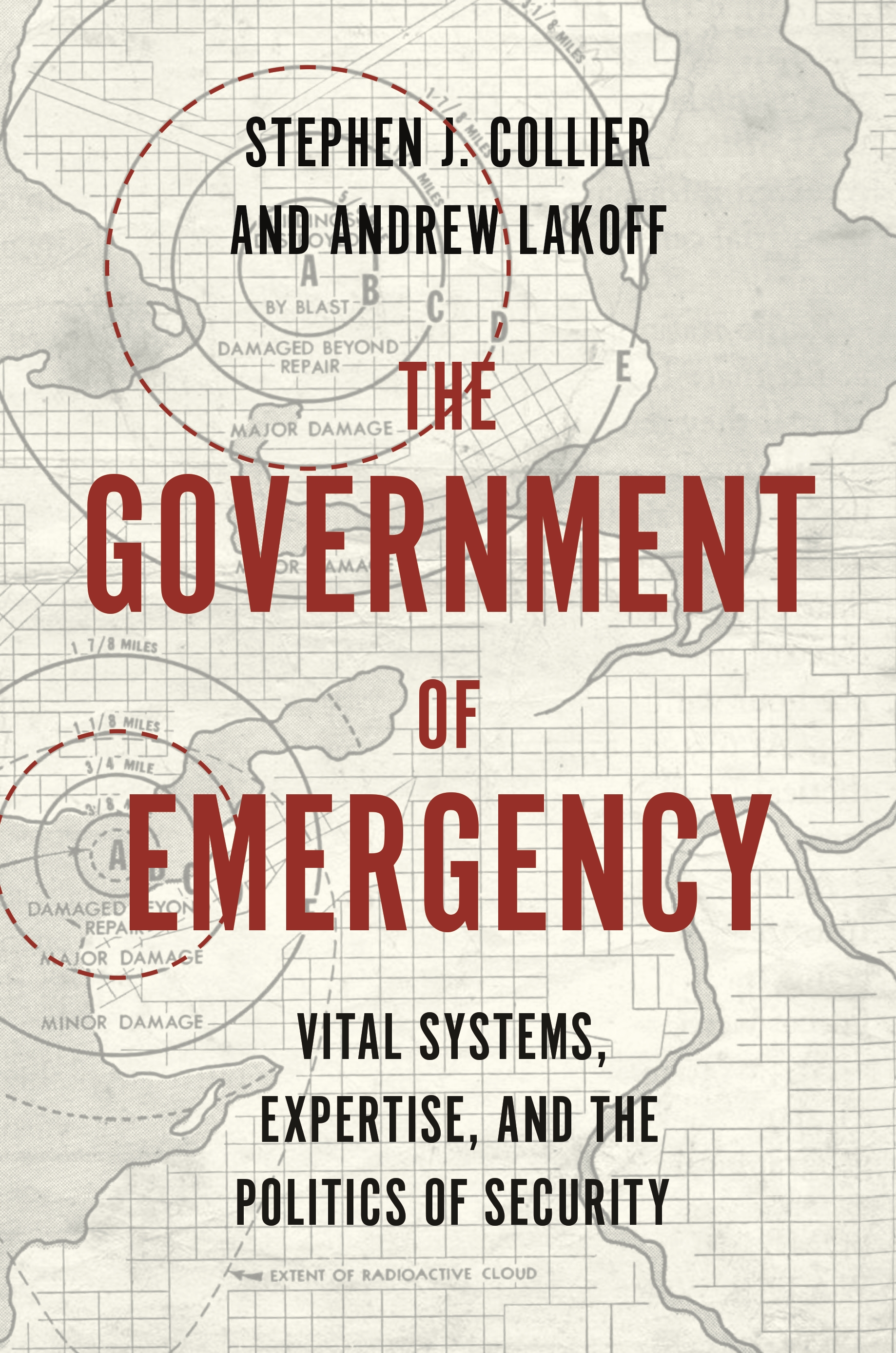
“It’s commonplace to say that we live in an era characterized by risk and disaster, and to take for granted that our governments should be continually responding to crises already unfolding while preparing for catastrophes looming just over the horizon. In The Government of Emergency: Vital systems, expertise, and the politics of security, Stephen J. Collier and Andrew Lakoff unearth the origins of this particular view of an unstable and vulnerable world, and how it was constructed alongside the same knowledge regimes and governance practices that, in fact, produce the types of risks and disasters that threaten society today. The book presents a painstakingly-researched genealogy of a political rationality the authors call “vital systems security,” which envisions states as made up of complexly interdependent flows of resources. It is these resource flows, rather than national populations, that have become the object of modern emergency preparedness and national security practices. In other words, the book explores how it is that institutional disaster preparedness has come to be dominated by the idea of “critical infrastructure” protection and resilience, and how it is that we came to see ourselves as “unprepared” for future disasters.
The Government of Emergency is a thrilling intellectual history. It is also an important contribution to a growing line of scholarship that critically approaches the concept of “disaster” itself. This scholarship, including work like Ted Steinberg’s Acts of God: The unnatural history of natural disasters in America (2000), Lisa Stampnitzky’s Disciplining Terror: How experts invented “Terrorism” (2013), and Kasia Paprocki’s Threatening Dystopias: The global politics of climate change adaptation in Bangladesh (2021), show how institutions construct certain types of suffering and disruption into problems that are worthy of particular kinds of state intervention. Here, Collier and Lakoff are interested in the development of a strain of political logic that conceives of “a range of seemingly disparate phenomena, from nuclear attacks and economic shocks to hurricanes and disease outbreaks” as “common types of events that present similar kinds of problems” and call for similar types of solutions (5).”
Ryan Hagan, British Journal of Sociology
 Stephen J. Collier